
How to Play Omaha Poker: The Four-Card Game and the One Rule Everyone Gets Wrong
If you already know Texas Hold’em, you are most of the way to Omaha. The betting, the positions, and the hand rankings are identical. Only the card rules change.
This guide covers the rules, the betting, the crucial two-card rule, and the popular Hi-Lo split-pot version.
What is Omaha poker?
Omaha is a community-card game where the best five-card poker hand wins. It uses the same hand rankings as Hold’em, from high card up to the royal flush.
The most popular form is Pot-Limit Omaha, known as PLO. It is the second most played poker game in the world, behind Texas Hold’em.
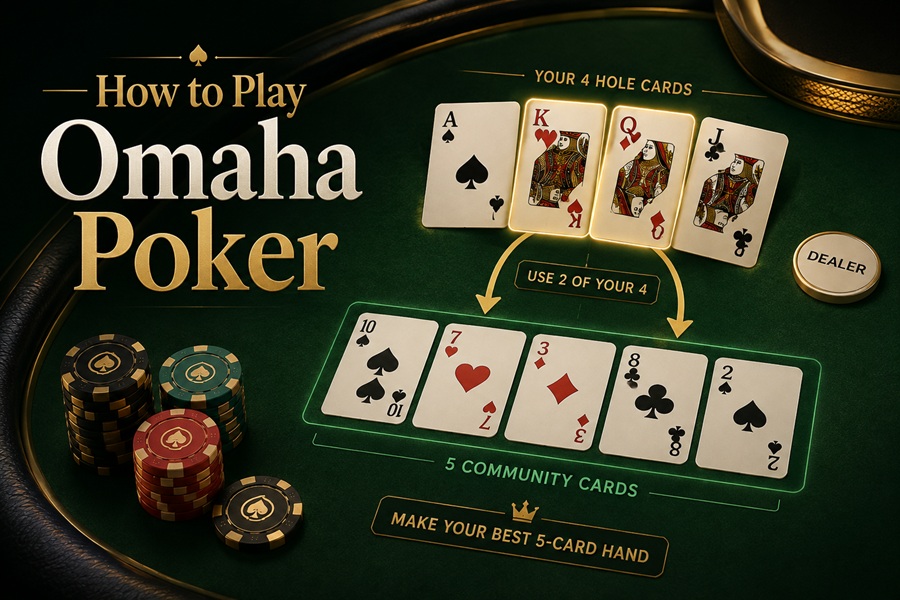
Each player receives four private cards. Five shared community cards are dealt face up across the table. Your job is to build the best five-card hand from that pool, following one strict rule.
The rule everyone gets wrong: exactly two plus three
This is the heart of Omaha, so read it twice.
You must use exactly two of your four hole cards and exactly three of the five community cards. No more, no less.
Compare that to Hold’em.
| Texas Hold’em | Omaha | |
|---|---|---|
| Hole cards dealt | 2 | 4 |
| Hole cards you must use | Any number (0, 1, or 2) | Exactly 2 |
| Community cards used | The rest of your five | Exactly 3 |
Here is where beginners lose money. Say the board shows four hearts and you hold the ace of hearts. In Hold’em, that ace gives you a flush. In Omaha, it does not, because you need two hearts in your hand, not one. One card is never enough.
Burn this into memory: two from your hand, three from the board, every single time.
How does a hand of Omaha play out?
The structure mirrors Hold’em exactly. There are four betting rounds.
- Preflop. Blinds are posted. Each player gets four hole cards. Betting starts left of the big blind.
- The flop. Three community cards are dealt face up. Another betting round follows.
- The turn. A fourth community card is dealt. Betting continues.
- The river. The fifth and final community card is dealt. A last betting round happens.
If two or more players remain, there is a showdown. Each player makes their best five-card hand using two hole cards and three community cards. The best hand wins the pot.
Players who are familiar with the button and blinds system will feel right at home. It is the same here.
How does pot-limit betting work in PLO?
The “pot-limit” part defines how much you can bet.
The maximum bet or raise is the current size of the pot. You cannot move all in for any amount like in no-limit. Your biggest legal bet is capped at what is already in the middle.
This changes the feel of the game. Pots build in stages rather than exploding in one all-in move. It also means position and pot control matter even more than in Hold’em.
Omaha can also be played as fixed-limit or, less commonly, no-limit. But pot-limit is the standard, which is why the game is usually just called PLO.
Why do hands look so much bigger in Omaha?
Because four hole cards create far more combinations.
With four cards instead of two, players make strong hands much more often. Two pair or a set, which can be a monster in Hold’em, is frequently second-best in Omaha.
That has two practical effects.
- Draws are stronger. Big wrap-around straight draws and flush draws are common and powerful.
- Made hands are worth less. A hand that would win in Hold’em often needs to improve in Omaha.
The takeaway: aim for hands that can make the near-best possible hand, not just a good one. In Omaha, second-best is expensive.
What is Omaha Hi-Lo (8 or Better)?
Omaha Hi-Lo, also called Omaha Eight or Better or PLO8, splits the pot between the best high hand and the best qualifying low hand.
The rules build on regular Omaha.
- You still use exactly two hole cards and three community cards. You can use different combinations for your high hand and your low hand.
- The high half follows normal poker rankings.
- The low half goes to the best hand made of five unpaired cards all ranked eight or lower.
- Aces count as low, so the best possible low is A-2-3-4-5, called “the wheel.”
- Straights and flushes do not count against a low hand.
If no one has a qualifying low (five cards eight or below), the high hand wins the whole pot. That is called scooping. Winning both halves yourself is also a scoop, and it is the goal.
Omaha Hi-Lo is most often played as a fixed-limit game and is a staple of mixed-game rotations.
What should a beginner focus on first?
A few priorities make the learning curve much gentler.
- Respect the two-card rule on every street until it becomes automatic.
- Play four cards that work together. Coordinated, connected, suited hands make strong five-card hands. Four random cards do not.
- Value position. Acting later gives you more information, which matters even more in Omaha’s big-draw pots.
- Practice first. Many players run a few free hands before playing for real money, just to get comfortable reading which two cards they are actually using.
Frequently asked questions
How many cards do you get in Omaha? Four hole cards, plus five shared community cards on the table.
Can I use just one hole card in Omaha? No. You must use exactly two hole cards and exactly three community cards.
Is Omaha harder than Texas Hold’em? The rules are similar, but the four-card structure creates more combinations and tougher decisions.
What does PLO stand for? Pot-Limit Omaha, the most popular form, where the maximum bet is the size of the pot.
What is the best low hand in Omaha Hi-Lo? A-2-3-4-5, known as the wheel, since aces play low and straights do not count against the low.
Are the hand rankings different from Hold’em? No. Omaha uses the same hand rankings. Only the card-usage rule changes.

Leave a reply


-
Instant Withdrawal Casinos: What Really Controls How Fast You Get Paid
Winning is easy. Getting paid fast is where casinos separate themselves. “Instant ... -
-
-
-
-