Category: BlackJack

  • What Is Double Down in Blackjack? When to Use It

    What Is Double Down in Blackjack? When to Use It

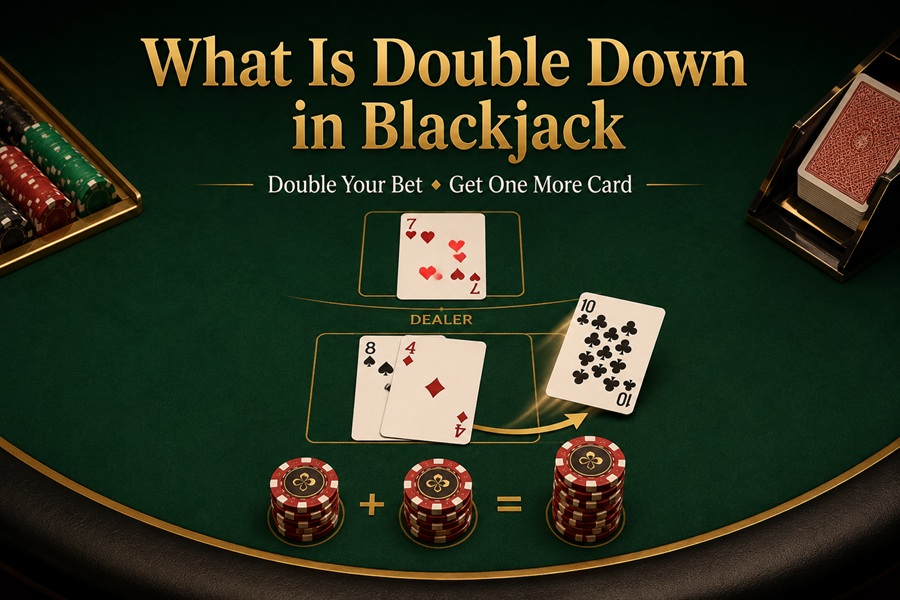
    Quick answer: Doubling down means doubling your original bet in exchange for exactly one more card, after which your hand is finished. You do it when your two cards are strong and the dealer’s upcard is weak, so the extra card is likely to turn a good hand into a winning one. The classic double is 11 against a weak dealer card. Double at the right moments and you gain money over time. Double at the wrong ones and you hand the edge back.

    Doubling down is where blackjack rewards knowing the math. It is a bet that you are in a strong spot, backed by putting more money on the line for one decisive card.

    This guide explains what doubling down is, exactly when to do it, when to avoid it, and how table rules change the picture.

    What does doubling down actually mean?

    When you double down, three things happen.

    1. You increase your bet, usually up to double the original.
    2. You receive exactly one more card.
    3. Your hand is then complete. You cannot hit again.

    It is a commitment. You are trading flexibility (the option to take more cards) for the chance to win a bigger payout on a hand you expect to win.

    You signal it by placing a matching stack of chips next to your original bet. Online, you click the “double” button.

    Why does doubling down work?

    Because it puts more money in when you are most likely to win.

    Blackjack has a small number of spots where your two cards are strong and the dealer is in trouble. In those moments, one more card often completes a powerful total, and the dealer’s weak upcard means they are likely to bust.

    Doubling is about maximizing value in those exact situations. It does not create wins on its own. It amplifies the wins you were already favored to get.

    That is the key idea: doubling is not aggression for its own sake. It is a precise bet placed only when the odds justify a bigger wager.

    When should you double down?

    Basic strategy gives clear answers. Here are the reliable doubles in a standard game.

    Hard totals

    Your hand Double against dealer showing
    11 Almost always (2 through 10, and often Ace)
    10 2 through 9
    9 3 through 6

    Soft hands (an Ace counted as 11)

    Your hand Double against dealer showing
    A-7 (soft 18) 3 through 6
    A-6 (soft 17) 3 through 6
    A-4 or A-5 (soft 15 or 16) 4 through 6
    A-2 or A-3 (soft 13 or 14) 5 through 6

    The pattern is easy to remember. You double when you hold a strong total, or a flexible soft hand, and the dealer shows a weak card (often 4, 5, or 6, the cards most likely to make them bust).

    When should you not double down?

    Doubling in the wrong spot is a common and expensive mistake. Avoid it here.

    • Against a strong dealer card with a marginal hand. If the dealer shows a 9, 10, or Ace and you do not have 11, doubling is usually wrong.
    • On a hard 12 or higher. You risk busting on the single card with no upside big enough to justify it.
    • On low totals like 8 or less. One card rarely turns these into a winner.
    • When you only want one card anyway but the dealer is strong. Just hit instead.

    The discipline is knowing that doubling is a small set of specific plays, not something to do whenever you feel good about a hand.

    How do table rules change doubling?

    The rules a casino sets directly affect how valuable doubling is, and even a small change matters.

    • Double on any two cards is the best rule for you. More freedom to double means more chances to press an edge.
    • Double on 10 and 11 only is restrictive and raises the house edge by roughly 0.2 percent compared to doubling on anything.
    • Double after split (DAS) allowed is player-friendly. It lets you double on strong hands created by splitting.
    • No-hole-card rules (common in some European games) make doubling against a dealer Ace or 10 riskier, because the dealer can still reveal a blackjack and take your extra bet.

    Before you sit down, check which doubling rules apply. The more freedom to double, the better the game.

    Does doubling down help you win more?

    Yes, but only alongside correct basic strategy.

    Doubling on its own is not a magic profit button. Its value comes from doubling in exactly the right spots, which requires knowing basic strategy. Used correctly, the extra bets you place in favorable situations add up and lower the overall house edge.

    Players who learn the doubling rules and apply them consistently, without emotional deviations, capture that value. Players who double on a hunch give it away.

    Frequently asked questions

    What is doubling down in blackjack?

    Doubling your bet in exchange for exactly one more card, after which your hand ends.

    What is the best hand to double down on?

    11, especially against a weak dealer upcard. It is the strongest and most frequent double.

    Can I take more than one card after doubling?

    No. You receive exactly one card, then your hand is complete.

    Should I double a soft 18?

    Yes, against a dealer showing 3 through 6. Otherwise, play it differently based on strategy.

    Does doubling on any two cards help me?

    Yes. It is the most player-friendly doubling rule and lowers the house edge.

    Can I double after splitting?

    Only if the table allows double after split (DAS). It is a favorable rule when offered.

  • Blackjack Online for Real Money: Where It Is Legal and How to Play Safely

    Blackjack Online for Real Money: Where It Is Legal and How to Play Safely

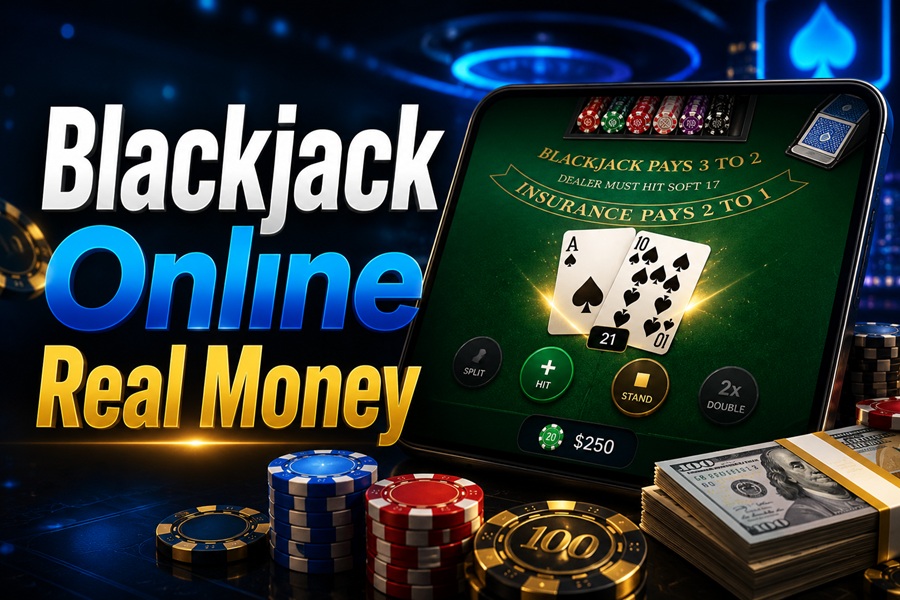
    Quick answer: You can play real-money online blackjack legally in seven US states: Connecticut, Delaware, Michigan, New Jersey, Pennsylvania, Rhode Island, and West Virginia. In those states, licensed casino apps offer both software (RNG) and live dealer blackjack to players aged 21 and up. Everywhere else, your legal options are sweepstakes casinos (free-to-play with real prize redemption) or nothing regulated at all. Offshore sites accept US players but carry real risk and no state protection.

    Online blackjack is convenient, fast, and available around the clock. But where you can legally play for real money depends entirely on your state. This is the part most guides blur, so here it is straight.

    This guide covers exactly where it is legal, how the games work, which payouts to avoid, and how to play safely.

    Where is real-money online blackjack legal?

    Legal, regulated online casino gaming exists in a small number of states. As of the most recent updates, seven states allow real-money online blackjack.

    State Regulated real-money online blackjack
    New Jersey Yes, the largest market
    Pennsylvania Yes
    Michigan Yes
    West Virginia Yes
    Connecticut Yes
    Delaware Yes
    Rhode Island Yes

    In these states, you must be 21 or older and physically located in the state to play. Apps confirm your location with geolocation.

    Because this list can change as more states legalize online casinos, always confirm the current status for your state before depositing.

    What can you play everywhere else?

    If your state is not on the list, you have two options, one legitimate and one risky.

    • Sweepstakes casinos. These operate under sweepstakes law in most states. You play with virtual currency and can redeem winnings for real prizes. They are legal in the large majority of states, though many focus on slots, and blackjack selection varies. Age limits are often 18 or older.
    • Offshore sites. These are licensed overseas and accept US players, but they are not regulated by any US state. That is a meaningful risk, covered below.

    Sweepstakes play is the mainstream legal workaround. Offshore play is a gamble on top of a gamble.

    How does real-money online blackjack work?

    Once you are in a legal state and registered, the flow is straightforward.

    1. Verify your identity and age with the licensed operator.
    2. Deposit funds. Minimums are often around $10 to $20.
    3. Choose a blackjack table that fits your bankroll.
    4. Place your bet, play the hand, and withdraw winnings through verified payment methods.

    Table minimums typically start around $1 to $5 for software blackjack and $5 to $25 for live dealer games. You can usually try games in free demo mode before betting real money.

    RNG blackjack versus live dealer: what is the difference?

    Regulated sites offer two formats, and they feel very different.

    • RNG (software) blackjack. A random number generator shuffles and deals. It is fast, private, and available at low stakes. The software is independently tested for fairness.
    • Live dealer blackjack. A real human dealer runs the game from a studio, streamed to you in real time, with real cards. It is slower and more social, with higher minimums.

    Both are legitimate at licensed casinos. RNG is best for volume and low stakes. Live dealer is best for atmosphere.

    How do you know an online blackjack game is fair?

    Fairness at licensed casinos is verifiable, not a matter of trust.

    • Regulated games use certified random number generators, independently tested by auditors such as eCOGRA, iTech Labs, or Gaming Laboratories International.
    • Licensed operators display their regulator and testing information.
    • Reputable game providers are listed openly.

    If a site hides its licensing or testing details, treat that as a red flag and walk away.

    What payout rule should you avoid online?

    This one rule quietly doubles the house edge, and many online tables use it.

    Look at what blackjack pays. The standard is 3:2. Some online (and video) blackjack tables pay only 6:5. That change alone raises the house edge by more than a full percent, which is terrible value over time.

    The rule is simple: seek out 3:2 tables and avoid 6:5 whenever you have the choice. A game that pays 6:5 is a worse deal even if everything else looks identical.

    Why are offshore sites risky?

    Because when something goes wrong, you have no one to appeal to.

    Offshore casinos operate outside US regulation. That creates concrete problems.

    • No state consumer protection. If your account is frozen or a withdrawal is refused, no US regulator can help you.
    • No guaranteed payouts. Getting paid depends entirely on the site’s willingness.
    • Uncertain fairness. Without recognized testing, you cannot verify the games.

    Experienced players in online communities repeat the same warning: stick to regulated, in-state operators, and treat unregulated offshore sites as a last resort you are better off avoiding.

    How can you play responsibly online?

    Online play removes the friction of a physical casino, which makes discipline more important.

    • Set a deposit limit and a loss limit before you start.
    • Use the responsible-gaming tools licensed sites are required to offer, like session timers and self-exclusion.
    • Never chase losses by re-depositing.
    • Treat blackjack as entertainment with a cost, not a way to make money.

    Frequently asked questions

    Is online blackjack for real money legal in the US?

    Yes, in seven states: Connecticut, Delaware, Michigan, New Jersey, Pennsylvania, Rhode Island, and West Virginia.

    How old do I have to be?

    21 or older in the regulated states. Sweepstakes sites are often 18 or older.

    Can I play if my state has no legal online casino?

    You can use sweepstakes casinos in most states, which offer real prizes through a virtual-currency model.

    What is the difference between RNG and live dealer blackjack?

    RNG uses tested software to deal. Live dealer uses a real human dealer streamed in real time.

    What payout should I look for?

    3:2 on blackjack. Avoid 6:5 tables, which have a much higher house edge.

    Are offshore blackjack sites safe?

    They are unregulated and offer no US consumer protection or guaranteed payouts. Regulated in-state sites are far safer.