What Is the House Edge in Blackjack? The Rules That Move It From 0.5% to 2%
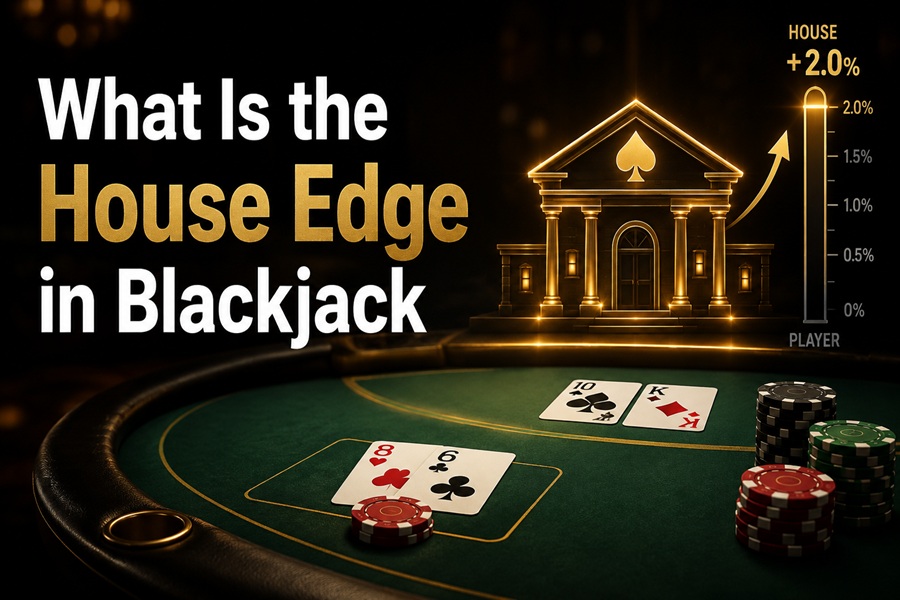
Quick answer: The house edge in blackjack is the casino’s built-in mathematical advantage. With perfect basic strategy and good table rules, it drops to roughly 0.5 percent, one of the lowest of any casino game. But that number is not fixed. Table rules move it a lot. A single bad rule, blackjack paying 6:5 instead of 3:2, can push the edge above 1.4 percent on its own. Blackjack is only a great bet when you play the right rules the right way.
Blackjack is famous for having a tiny house edge. That reputation is earned, but only under specific conditions. Change a rule or misplay a hand, and the edge climbs fast.
This guide explains what the house edge is, the exact number under good conditions, and every rule that moves it up or down.
What is the house edge?
The house edge is the percentage of each bet the casino expects to keep over the long run.
A 0.5 percent house edge means that, on average, you lose 50 cents for every $100 wagered over a very large number of hands. It does not predict any single session. It describes the long-term math.
Blackjack stands out because your decisions change this number. In most casino games, you cannot affect the edge at all. In blackjack, how you play each hand directly determines how big the house edge is.
What is the house edge with basic strategy?
Low, and that is the whole appeal.
Blackjack is a “solved” game. Computers have calculated the mathematically best play for every hand against every dealer upcard. That set of plays is called basic strategy.
Play it perfectly under good rules, and the house edge falls to roughly 0.5 percent. Under especially favorable rules, it can dip toward 0.3 percent.
Here is the contrast that matters.
| How you play | Approximate house edge |
|---|---|
| Perfect basic strategy, good rules | About 0.5% |
| Casual play with common mistakes | 1.5% to 2.5% or more |
The gap between those two is entirely in your hands. Learning basic strategy is the single biggest edge-reducer available to any player.
Why does the house have an edge at all?
Because of one rule: you act first.
You make all your decisions before the dealer plays. If you bust, you lose immediately, even if the dealer would have busted too on the same hand. That “player acts first” rule is the root of the casino’s advantage.
Player-favorable rules exist to offset it, like getting 3:2 on a natural blackjack, doubling down, splitting, and surrender. Those benefits pull the edge down from a very high starting point to the small final number. But the “act first” disadvantage is why an edge remains.
Which rules raise or lower the house edge?
This is the practical heart of the matter. The same game can be a great bet or a bad one depending on the rules posted at the table.
| Rule | Effect on house edge |
|---|---|
| Blackjack pays 3:2 | Standard and good for you |
| Blackjack pays 6:5 | Bad. Raises the edge by more than 1% |
| Dealer stands on soft 17 (S17) | Better for you |
| Dealer hits on soft 17 (H17) | Worse for you |
| Double on any two cards | Better for you |
| Double after split (DAS) allowed | Better for you |
| Fewer decks | Better for you |
| Surrender offered | Better for you |
The best tables combine several of these: 3:2 payouts, dealer stands on soft 17, double after split allowed, and fewer decks. Those conditions give you the lowest possible edge.
Why is 6:5 blackjack the rule to avoid?
Because it quietly costs you more than any other single change.
Standard blackjack pays 3:2, so a $10 blackjack wins $15. A 6:5 table pays only $12 on that same blackjack. You get shortchanged every time you hit a natural.
That one change raises the house edge by more than a full percent, often turning a 0.4 percent game into something near 1.4 percent or worse. It is the most common trap on modern casino floors.
Watch for it especially on single-deck and video blackjack tables, which frequently use 6:5 to cancel out their other advantages. Fewer decks do not help you if the payout is 6:5.
How do the number of decks affect the edge?
Fewer decks favor the player, all else being equal.
- Fewer decks slightly raise your chances of being dealt a natural blackjack.
- Fewer decks give you a little more information about what remains.
But this only matters if the other rules are good. A single-deck game that pays 6:5 is worse than a six-deck game that pays 3:2. Always weigh the payout rule first, then the deck count.
How do you get the house edge as low as possible?
Four steps capture almost all of the value.
- Learn basic strategy and follow it without emotional deviations. This is the biggest single factor.
- Choose good tables: 3:2 payouts, dealer stands on soft 17, double after split allowed.
- Avoid 6:5 tables entirely. This one rule undoes the benefit of everything else.
- Play fewer decks when the other rules are equal.
Do these and you are playing one of the lowest-edge games in the building. Skip them and blackjack becomes just another game where the house wins comfortably.
Note that card counting can, in theory, shift the edge toward a skilled player over time, but it requires significant practice and casinos actively discourage it. For nearly all players, basic strategy plus good rules is the realistic goal.
Frequently asked questions
What is the house edge in blackjack?
With perfect basic strategy and good rules, roughly 0.5 percent, one of the lowest in the casino.
What raises the house edge the most?
Blackjack paying 6:5 instead of 3:2. It adds more than a full percent on its own.
Does basic strategy really lower the edge?
Yes. It is the single biggest factor, taking the edge down to around 0.5 percent.
Are fewer decks better?
Yes, all else equal. But a good payout rule matters more than deck count.
What rules should I look for?
3:2 payouts, dealer stands on soft 17, double after split allowed, and fewer decks.
Can the house edge be beaten?
Skilled card counting can shift it, but it is difficult and discouraged. Basic strategy plus good rules is the practical goal.

Leave a reply

-
Instant Withdrawal Casinos: What Really Controls How Fast You Get Paid
Winning is easy. Getting paid fast is where casinos separate themselves. “Instant ... -
-
-
-
-