How to Play Ultimate Texas Hold’em: The 4x/2x/1x Decisions That Decide Your Edge
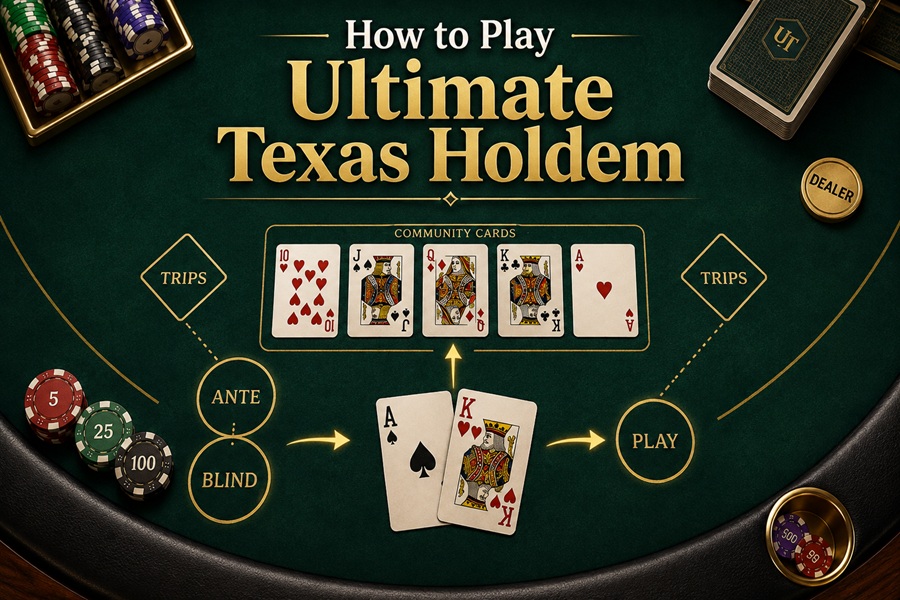
Quick answer: Ultimate Texas Hold’em is a casino table game where you play a five-card poker hand heads-up against the dealer, not other players. You post two equal bets (Ante and Blind), then decide when to make one Play bet. The earlier you commit, the bigger you can bet: up to 4x your Ante before the flop, 2x after the flop, or just 1x at the river. With correct strategy the house edge is low, but betting badly can push it toward 14 percent. When you bet is the whole game.
Ultimate Texas Hold’em looks like poker, but you never play against the table. You are trying to beat only the dealer’s hand. The skill is not bluffing. It is knowing exactly when to raise and how much.
This guide covers the setup, the three decision points, the payouts, the house edge, and a simple strategy.
How is Ultimate Texas Hold’em set up?
The game uses a standard 52-card deck. You and the dealer each get two hole cards, and five community cards come out across the hand, just like regular Hold’em.
To start, you place three possible wagers.
- Ante: a mandatory bet.
- Blind: a mandatory bet, equal to the Ante.
- Trips: an optional side bet (covered later).
The Ante and Blind must be the same amount. If you bet $5 on each, your starting commitment is $10 before any cards are dealt.
Your goal is simple: make a better five-card poker hand than the dealer.
How does the betting work? The 4x, 2x, 1x decisions
This is the core of the game. You get to make one Play bet, and you choose when. The earlier you commit, the more you are allowed to wager.
| Decision point | What you see | Play bet options |
|---|---|---|
| Pre-flop | Your two hole cards | Check, or bet 3x or 4x Ante |
| After the flop | Three community cards | Check, or bet 2x Ante |
| After the river | All five community cards | Bet 1x Ante, or fold |
You only bet once. If you check pre-flop, you get another chance after the flop. If you check again, you must either make the minimum 1x bet at the river or fold and lose your Ante and Blind.
The logic is built in: strong starting hands should raise big and early, while weak hands should wait or fold.
How are hands resolved against the dealer?
Two things decide your payout: whether the dealer qualifies, and who has the better hand.
- Dealer qualification. The dealer needs at least a pair to qualify. If the dealer does not qualify, your Ante pushes (it is returned), while your Play and Blind bets are still in action.
- Beating the dealer. If your hand beats the dealer’s, your Ante and Play bets pay even money. The Blind pays on a bonus scale.
- Losing. If the dealer wins, you lose your Ante, Blind, and Play bets.
- Tie. All bets push.
The Blind bet is special. It only pays a bonus when you win with a straight or better. On any smaller winning hand, the Blind simply pushes.
What are the payouts?
The Ante pays 1:1 when you win. The Blind pays on a rising scale tied to your hand strength.
A typical Blind pay table looks like this.
| Winning hand | Blind pays |
|---|---|
| Royal flush | 500:1 |
| Straight flush | 50:1 |
| Four of a kind | 10:1 |
| Full house | 3:1 |
| Flush | 3:2 |
| Straight | 1:1 |
| Less than a straight | Push |
The optional Trips side bet pays on your own final hand, three of a kind or better, no matter what the dealer has. Payouts commonly run from about 3:1 for trips up to 50:1 for a royal flush.
What is the house edge in Ultimate Texas Hold’em?
Low, if you play well. Costly, if you do not.
With optimal strategy, the house edge is about 2.2 percent per Ante bet. But because you typically wager around four times your Ante across a full hand, the “element of risk” (the edge relative to your total money bet) is only about 0.53 percent. That makes it one of the better-value table games in the casino.
Here is the catch. Play badly, and the edge explodes.
| How you play | Approximate house edge |
|---|---|
| Optimal strategy | About 2.2% per Ante (0.53% element of risk) |
| Betting 4x on every hand blindly | Around 14% |
No mainstream table game has this big a gap between good and bad play. Learning the strategy is not optional if you care about your money.
The Trips side bet carries its own higher edge, often around 3.5 percent depending on the pay table, so treat it as a fun extra, not a core bet.
What is the basic strategy?
You do not need to memorize a huge chart. A few rules capture most of the value.
Pre-flop (bet 4x when strong):
- Bet 4x with any pair of 3s or higher.
- Bet 4x with any Ace.
- Bet 4x with most King hands (K-2 suited or better, K-5 offsuit or better).
- Bet 4x with strong Queen and connected suited hands.
- Check everything else.
After the flop (bet 2x):
- Bet 2x with two pair or better.
- Bet 2x with a hidden pair, or a strong draw plus a pair.
- Otherwise check.
At the river (bet 1x or fold):
- Make the 1x bet if your hand can beat the dealer’s likely holdings.
- A common guide: bet if fewer than 21 of the dealer’s possible cards would beat you.
- With less than a pair and no case to bet, folding is usually correct.
Stick to these and your edge stays near that low 0.53 percent element of risk.
Frequently asked questions
Do I play against other players in Ultimate Texas Hold’em?
No. You play only against the dealer’s hand.
How big can my Play bet be?
Up to 4x your Ante pre-flop, 2x after the flop, or 1x at the river. You bet once.
What happens if the dealer does not qualify?
The dealer needs a pair to qualify. If not, your Ante pushes while Play and Blind bets still get action.
Is the Trips bet worth it?
It is a fun side bet with a higher house edge. Keep it small and treat it as optional.
What is the house edge?
About 2.2 percent per Ante with optimal play, or roughly 0.53 percent as an element of risk.
Why does the Blind bet sometimes push on a win?
The Blind only pays a bonus on a straight or better. Smaller winning hands push it.

Leave a reply

-
Instant Withdrawal Casinos: What Really Controls How Fast You Get Paid
Winning is easy. Getting paid fast is where casinos separate themselves. “Instant ... -
-
-
-
-