Tag: betting odds

  • How Does Sports Betting Work? Odds, Lines, and the Vig Explained Step by Step

    How Does Sports Betting Work? Odds, Lines, and the Vig Explained Step by Step

    Quick answer: Sports betting works by placing money on an outcome at a fixed price called the odds. A sportsbook (the bookmaker) sets a line for each game. You choose a side, the book locks your price, and you win a payout tied to that price if your pick lands. The book builds in a small charge on every bet, called the vig, which is how it makes money whether you win or lose.

    Sports betting looks complicated from the outside. It is not. Once you learn three bet types and one number (the odds), you can read almost any betting screen.

    This guide walks through the whole cycle. From how a line is set, to how your payout is calculated, to where your money actually goes.

    What actually happens when you place a bet?

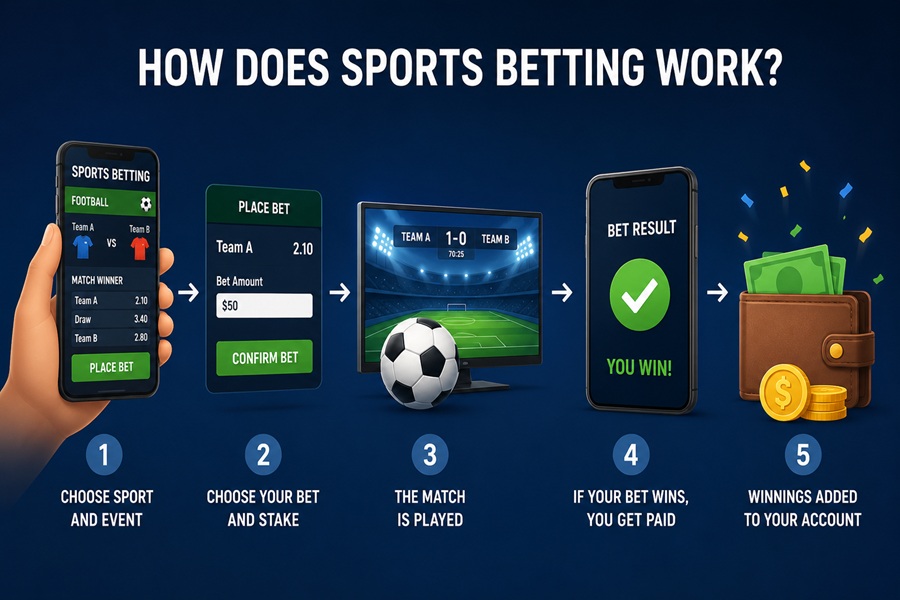
    Every bet follows the same five steps.

    1. The sportsbook posts a line for a game.
    2. You pick a side and a bet type.
    3. The book shows you a price (the odds) and a potential payout.
    4. Your money is held as the stake.
    5. When the game ends, you either get your stake plus profit, or you lose the stake.

    The book’s job is to attract roughly equal money on both sides. When the money is balanced, the book collects its built-in fee no matter who wins.

    That fee is the single most important thing new bettors miss. We cover it below.

    How do you read betting odds?

    Odds tell you two things at once: how likely the book thinks an outcome is, and how much you get paid.

    In the United States, odds use plus and minus signs. This is called American odds.

    Odds format What it means Example
    Negative (favorite) How much you must stake to win $100 -150 means risk $150 to win $100
    Positive (underdog) How much you win on a $100 stake +200 means a $100 stake wins $200

    A quick way to read it:

    • A minus number is the favorite. The bigger the minus, the stronger the favorite.
    • A plus number is the underdog. The bigger the plus, the bigger the potential payout.

    You do not have to bet exactly $100. The odds simply scale. A $10 stake at +200 wins $20. A $30 stake at -150 wins $20.

    Insight most guides skip: odds are just probability in disguise. A -150 price implies about a 60 percent chance. A +200 price implies about a 33 percent chance. Once you can convert odds to a percentage, you can spot when a price looks too generous or too short.

    What are the three main bet types?

    Almost every bet you will ever place is one of these three. Learn them and the rest is detail.

    1. Moneyline: who wins, plain and simple

    A moneyline bet is a bet on the outright winner. The margin does not matter. Win by one point or thirty, the bet pays the same.

    • Favorite: negative odds, smaller payout.
    • Underdog: positive odds, bigger payout.

    Use the moneyline when you are confident an underdog can win outright, or when a game is close to a coin flip.

    2. Point spread: the handicap that levels the game

    The point spread gives the underdog a head start and asks the favorite to win by more than a set number.

    If a football favorite is listed at -6.5, they must win by 7 or more for the bet to cash. The underdog at +6.5 wins the bet if they lose by 6 or fewer, or win the game.

    Spread bets are usually priced around -110 on both sides. That -110 is the fee (more on that next).

    Spreads have different names in different sports:

    • Run line in baseball, usually set at 1.5 runs.
    • Puck line in hockey, usually set at 1.5 goals.
    • Asian handicap in soccer, which can use quarter goals like -0.25 or -1.25.

    3. Totals (over/under): the combined score

    A totals bet ignores who wins. You bet on whether the combined score of both teams will go over or under a number the book sets.

    If a total is 44.5, an over bet needs 45 or more combined points. An under needs 44 or fewer. Totals also price around -110 on each side.

    Totals are driven by pace, weather, and key injuries. Wind above 15 mph in football, for example, is one of the most reliable signals that a total may stay low.

    A worked example: reading one game screen

    Here is a single football game as it would appear at any sportsbook.

    Team Spread Total Moneyline
    Chargers +6.5 (-110) Over 44.5 (-110) +230
    Jets -6.5 (-110) Under 44.5 (-110) -280

    From this one row you can read everything:

    • The Jets are the favorite (minus moneyline, minus spread).
    • The Chargers are the underdog getting 6.5 points.
    • The book expects a mid-scoring game (44.5 total).
    • A $100 moneyline bet on the Chargers would win $230. The same bet on the Jets would need a $280 stake to win $100.

    What is the vig, and why does it matter more than winning percentage?

    The vig (also called juice) is the small fee baked into the odds. It is the reason a spread is priced -110 instead of +100.

    Here is the math that trips up beginners.

    At -110, you risk $110 to win $100. If you bet two even games and go one for one, you do not break even. You win $100 on one and lose $110 on the other. Net loss: $10.

    That gap is the house edge. It means you need to win about 52.4 percent of spread bets just to break even, not 50 percent.

    This is the number that separates casual bettors from disciplined ones. Shopping for better prices, even -105 instead of -110, adds up over hundreds of bets.

    What other bet types should you know?

    Once the big three click, these expand your options.

    • Parlays: several bets combined into one ticket. All legs must win. Bigger payout, much lower odds of hitting.
    • Player props: bets on an individual, like passing yards or points scored.
    • Futures: long-term bets, like a team to win the championship.
    • Live (in-play) betting: odds that update in real time as the game unfolds.
    • Same-game parlays: multiple props from one game bundled together.

    Parlays and same-game parlays carry a much larger built-in edge for the book. They are fun, but they are the most expensive way to bet over time.

    What happens if the game lands exactly on the number?

    This is called a push. If a spread is -3 and the favorite wins by exactly 3, the bet is a push. Your stake is returned. No win, no loss.

    Books avoid pushes by using half-points, like -3.5. That guarantees a winner and a loser. This is also why numbers like 3 and 7 matter so much in football, since many games are decided by those exact margins.

    Why do the lines keep moving?

    A line is not fixed. It moves for two reasons.

    1. Money. If too much is wagered on one side, the book shifts the line to attract action to the other side and stay balanced.
    2. Information. A key injury, a lineup change, or bad weather can move a line fast.

    When a spread moves sharply in the hours before kickoff, it often reflects large, informed bets. Tracking that movement is one of the oldest skills in betting.

    How do sportsbooks always seem to win?

    They do not win every bet. They win over volume.

    By balancing the money and charging the vig, a book profits on the difference regardless of the result. Their edge is structural, not lucky.

    The whole US market shows the scale. Commercial sportsbooks took in roughly $167 billion in wagers last year, according to the American Gaming Association. Even a small percentage held on that much money is enormous.

    What are prediction markets, and how are they different?

    This is the fastest-moving story in betting, and most beginner guides ignore it.

    Prediction markets like Kalshi let people trade contracts on real-world outcomes, including sports. Prices are set by supply and demand, like a stock exchange, not by a bookmaker setting a line.

    The growth has been staggering. During the most recent World Cup, prediction markets captured around 27 percent of all legal US sports-betting volume, up from about 9 percent at the start of the year. Kalshi’s daily app users briefly passed both DraftKings and FanDuel.

    Why it matters to you as a beginner:

    • Prices move like markets, so you can often trade out of a position before an event ends.
    • They operate under federal (CFTC) oversight rather than state sportsbook rules, which is why they are available in some states where traditional sportsbooks are not.
    • The legal picture is still contested, with several states pushing back.

    You do not need to use them. But you should know they exist, because they are reshaping how Americans bet.

    What do experienced bettors say new bettors get wrong?

    Community forums like Reddit’s r/sportsbook and long-running betting boards repeat the same lessons. They are worth more than any tip service.

    • Manage your bankroll. Bet a fixed unit, usually 1 to 2 percent of your total betting funds, per wager. This keeps one bad night from wiping you out.
    • Never chase losses. Raising your stakes to win back a loss is the fastest route to a busted account.
    • Shop for the best line. The same bet is priced differently at different books. Small edges compound.
    • Ignore the hype. Screenshots of huge winning parlays are cherry-picked. Consistent small edges beat lottery tickets.
    • Treat it as entertainment money. Only bet what you can afford to lose.

    The single most repeated point across every forum is discipline over prediction. Knowing the games matters. Managing your money matters more.

    How do you place your first bet, step by step?

    1. Confirm betting is legal in your state.
    2. Register with a licensed, regulated sportsbook and verify your identity.
    3. Deposit funds. Start small.
    4. Pick a game and a bet type you understand (moneyline is the simplest start).
    5. Enter your stake. The app shows your exact payout before you confirm.
    6. Confirm and track the bet.

    Stick to bet types you can explain in one sentence until they feel automatic.

    Frequently asked questions

    Is sports betting the same as gambling?

    Yes. It carries real financial risk, and outcomes are never guaranteed.

    What is the easiest bet type for beginners?

    The moneyline. You are only picking a winner, with no spread or total to track.

    How much should I bet per game?

    Most disciplined bettors risk 1 to 2 percent of their bankroll per bet.

    Can I always win if I study enough?

    No. Even sharp bettors lose regularly. The goal is a long-term edge, not perfection.

    Where does my money go?

    Your stake is held by the book. Winners are paid from the pool, and the book keeps the vig as its fee.