Tag: Sports Betting

  • Is Sports Betting Legal in South Carolina? The Law, the Stalled Bills, and Legal Alternatives

    Is Sports Betting Legal in South Carolina? The Law, the Stalled Bills, and Legal Alternatives

    Quick answer: No. Sports betting is not legal in South Carolina. The state has no licensed sportsbooks, no retail betting shops, and no approved online apps. Both online and in-person sports wagering remain prohibited under state law. Lawmakers have introduced bills to change this, but none have passed.

    South Carolina is one of a shrinking group of states holding out on legal sports betting. Neighbors have moved ahead. The Palmetto State has not. Here is the current law, why every attempt keeps stalling, and what residents can and cannot legally do instead.

    Is sports betting legal in South Carolina right now?

    No. There is no legal, regulated sports betting in South Carolina.

    • No licensed online sportsbooks operate in the state.
    • No retail sportsbooks or betting shops exist.
    • The state has no commercial land-based casinos either.

    South Carolina has one of the most restrictive gambling environments in the country. There is very little history of legal gambling of any kind to build on, which is part of why change has been slow.

    Why does sports betting keep failing in South Carolina?

    The demand exists. The votes in the legislature do not.

    Supporters have introduced bill after bill over multiple sessions. Each one has stalled before becoming law. The reasons repeat.

    • A conservative gambling stance. The state has long resisted expanding legal gambling in any form.
    • Constitutional hurdles. Some proposals would require amending the state constitution, which needs a statewide vote, not just a legislative majority.
    • Committee bottlenecks. Bills tend to die in committee rather than reaching a floor vote.

    The furthest any recent bill has advanced was a Senate committee hearing on a proposal (SB 444) earlier this year. That was progress by South Carolina standards, but it still did not create a legal market.

    What is the current legislative status?

    Here is a plain-language tracker of the recent effort.

    Bill / effort Goal Outcome
    Earlier framework bills Establish a betting framework Failed to advance
    HB 5277 Legalize retail and online betting Stalled
    HB 3625 (Sports Wagering Act) Legalize mobile betting Stalled in House Judiciary Committee
    S 327 / S 444 Authorize wagering, possibly via public vote Committee hearing held, no market created

    When the most recent legislative session hit its deadline, lawmakers left without moving either the House or Senate proposals far enough to matter. So the state entered the current period with no legal market and no bill advancing.

    Could South Carolina legalize sports betting soon?

    It is possible, but the timeline is uncertain.

    Two factors will shape what happens next.

    1. The governor’s race and stance. The next administration’s position on gambling could decide whether future bills gain momentum. Leadership support has been a missing ingredient.
    2. Regional pressure. North Carolina launched mobile betting and has generated substantial tax revenue. Tennessee already allows it. Watching neighbors collect money that South Carolina forfeits adds political pressure.

    If a bill ever does pass, launch would not be instant. In other states, sportsbook apps typically go live six months to a year after a law is signed. So even a breakthrough would mean a wait.

    What can South Carolina residents legally do instead?

    This is the practical question, and it is where most guides get vague. Here is a clear breakdown.

    Legal, regulated in some form

    • Daily fantasy sports (DFS). Contest-based platforms operate in the state. They are skill-based games, not fixed-odds betting.
    • Prediction markets. Federally regulated platforms like Kalshi offer sports-outcome contracts. They operate under a different framework than sportsbooks, and their nationwide legal status is still being contested in courts and by state regulators. Treat them cautiously.
    • Sweepstakes-style social platforms. These use a virtual-currency model. Note that at least one has faced a lawsuit in South Carolina alleging it amounts to illegal gambling, so the legal ground is not settled.

    Not legal or not protected

    • In-state sportsbooks. None exist. DraftKings, FanDuel, and similar apps are not available in South Carolina.
    • Offshore sportsbooks. Sites based overseas accept US customers, but they are unregulated. They offer no state consumer protection, no guaranteed payouts, and no recourse if something goes wrong. This is a real risk, not a technicality.
    • Betting across state lines. Residents can legally bet in states where it is allowed, but only while physically located there. Apps use geolocation to enforce this.

    What are the risks of offshore betting?

    Because South Carolina has no legal option, offshore sites market heavily to residents. Bettors should understand what they give up.

    • No consumer protection. If a site freezes your account or refuses a withdrawal, there is no state regulator to appeal to.
    • No guaranteed payouts. Winnings depend entirely on the site’s willingness to pay.
    • Tax obligations still apply. Under federal law, gambling winnings are taxable income even when won offshore.

    Regulated markets exist specifically to prevent these problems. South Carolina residents currently do not have that safety net in-state.

    How does South Carolina compare to its neighbors?

    The contrast is stark, and it is a big reason legalization keeps returning to the agenda.

    State Legal sports betting?
    South Carolina No
    North Carolina Yes, mobile betting is live
    Tennessee Yes, online-only
    Georgia No

    Two of South Carolina’s immediate neighbors already collect tax revenue from betting. Residents near those borders can, and do, drive across to place legal bets.

    What do South Carolina sports fans say online?

    On forums and community threads, the mood is a mix of frustration and workaround-hunting.

    • Many residents express frustration that neighboring states have moved ahead while South Carolina stalls.
    • Experienced posters consistently warn newcomers away from offshore sites, citing withdrawal problems and the lack of any recourse.
    • The most common practical tip is simple: if you want to bet legally, do it in a legal state while you are physically there, and never treat an unregulated offshore site as safe.

    The recurring theme is caution. Without a regulated market, the community leans hard on protecting people from the riskiest options.

    Frequently asked questions

    Is sports betting legal in South Carolina? No. There are no licensed sportsbooks, retail or online, in the state.

    Can I use DraftKings or FanDuel in South Carolina? No. Those apps are not available for betting within the state.

    Are prediction markets like Kalshi legal in South Carolina? They operate under federal oversight and are accessible, but their nationwide legal status is contested. Approach them as a distinct, still-uncertain product.

    Is it illegal to bet on offshore sites from South Carolina? The state does not typically prosecute individual bettors, but offshore sites are unregulated and offer no consumer protection or payout guarantee.

    Will South Carolina legalize sports betting? Possibly, but no bill is currently advancing, and the next governor’s stance may decide the timeline.

    Can I bet legally if I leave the state? Yes. You can bet in states where it is legal while you are physically located there.

  • Is Sports Betting Legal in Missouri? What Amendment 2 Changed and How to Bet Now

    Is Sports Betting Legal in Missouri? What Amendment 2 Changed and How to Bet Now

    Quick answer: Yes. Sports betting is legal in Missouri. Voters approved Amendment 2 in November 2024, and regulated online and retail betting officially launched on December 1, 2025. Anyone 21 or older who is physically in the state can bet with a licensed sportsbook. The Missouri Gaming Commission regulates the market.

    Missouri spent years watching neighbors take legal bets while its own residents could not. That changed at the ballot box. Here is exactly where the law stands, how it happened, and what you can do today.

    Missouri sports betting at a glance

    Detail Status
    Legal? Yes
    Live since December 1, 2025
    How it passed Amendment 2, voter-approved
    Minimum age 21
    Online betting Legal and live
    Retail (in-person) betting Legal and live
    Regulator Missouri Gaming Commission (MGC)
    Tax rate 10 percent of sportsbook revenue
    Where taxes go K-12 public education and problem-gambling programs

    Is online sports betting legal in Missouri?

    Yes. Both mobile and in-person betting are legal.

    You can register, deposit, and bet from a phone anywhere inside state lines. You must be physically located in Missouri when you place a wager. Sportsbook apps confirm this with geolocation.

    The law authorizes up to 14 online sportsbook licenses and up to 19 retail licenses. These are tied to the state’s casinos and its six professional sports teams, plus a small number of online-only operators.

    Which sportsbooks are live in Missouri?

    Eight online sportsbooks went live at launch. They represent the biggest national brands.

    • DraftKings
    • FanDuel
    • BetMGM
    • bet365
    • Caesars
    • Circa Sports
    • Fanatics Sportsbook
    • theScore Bet (formerly ESPN Bet)

    One operator, Underdog, received a license but opted out of sportsbook operations before launch. The lineup can shift as the market matures, so always confirm a book is licensed before depositing.

    How did Missouri legalize sports betting?

    For years, legalization stalled in the legislature. Lawmakers could not agree on the details. So supporters went around them.

    A coalition of the state’s six pro sports teams and major sportsbook operators, branded Winning for Missouri Education, gathered signatures to put the question directly to voters. They collected far more than the minimum required.

    The measure passed by one of the narrowest margins in state history: about 50.05 percent to 49.95 percent. A few thousand votes decided it.

    Here is the short timeline that matters.

    When What happened
    November 2024 Voters approve Amendment 2 by a razor-thin margin
    Through 2025 The Gaming Commission writes rules and licenses operators
    November 2025 Pre-registration opens; nearly 188,000 accounts created
    December 1, 2025 Legal online and retail betting goes live

    What can you bet on in Missouri?

    The full menu of standard markets is available across major pro and college sports.

    • Moneyline, spread, and totals
    • Player props and same-game parlays
    • Live, in-play betting
    • Futures, like division titles and season win totals

    Local action is a big draw. Bettors can build Chiefs same-game parlays, back the Cardinals on the run line, or take the Blues on the puck line.

    One notable regulatory decision: the Gaming Commission declined a request to ban college player prop bets, citing a lack of evidence to justify a ban. So college props remain available, unlike in some other states.

    How has the launch gone so far?

    Better than many expected.

    Early demand was strong. Active betting accounts more than doubled to roughly 520,000 in the first full week. Reported handle passed $73 million in the opening week alone.

    The appetite was clear even before launch. In one earlier Super Bowl, a geolocation firm reported blocking more than 431,000 attempts to reach sportsbooks from inside Missouri. That pent-up demand is now legal and captured in-state.

    What about taxes and where the money goes?

    Missouri taxes sportsbook revenue at 10 percent. That is a comparatively low rate.

    The proceeds are directed to public education and to gambling-addiction programs. Education funding was the central promise of the ballot campaign, reflected in its name.

    There has been debate about raising the rate. Lawmakers floated an increase from 10 percent to 34 percent, then removed the proposal to study early market data first. For now, the rate holds at 10 percent.

    How do you place a legal bet in Missouri?

    The process takes a few minutes.

    1. Confirm you are 21 or older and physically in Missouri.
    2. Download a licensed sportsbook app or visit a retail location.
    3. Register and verify your identity.
    4. Claim any welcome offer, then read its terms carefully.
    5. Deposit funds and place your first wager.

    If you live near a border, expect strict location checks. Books near the Arkansas line are especially careful, since Arkansas has its own rules. Being close to Illinois, Iowa, or Kansas is less of an issue, since those states also allow betting.

    What is different in Missouri: the prediction-market angle

    Here is context most Missouri guides leave out.

    Traditional sportsbooks are not the only way residents now bet. Prediction markets like Kalshi, which offer sports-outcome contracts under federal oversight, are also available to Missouri residents. Other prediction platforms have moved into the state as well.

    These operate under a different framework than licensed sportsbooks. They price contracts like an exchange rather than setting fixed odds. Their legal status nationally is still being contested, so treat them as a distinct product, not a regulated Missouri sportsbook.

    This matters because it gives Missourians two parallel ways to bet on the same games, each with different rules and protections.

    What do Missouri bettors say about the rollout?

    Community reaction on betting forums and local sports boards has been broadly positive, with a few recurring themes.

    • Bettors welcomed having every major national book available on day one, which made line shopping easy.
    • Border residents flagged geolocation headaches near Arkansas, echoing the official guidance above.
    • Experienced posters repeat the same caution everywhere: start with a set bankroll, bet small units, and treat promos as a bonus, not a strategy.

    The consistent advice from seasoned bettors is discipline first. A legal market is convenient, but the math still favors the house on every bet.

    Frequently asked questions

    Is sports betting legal in Missouri right now?

    Yes. It has been legal and live since December 1, 2025.

    What is the minimum age to bet in Missouri?

    You must be 21 or older.

    Can I bet online in Missouri?

    Yes. Mobile betting is legal statewide as long as you are physically in Missouri.

    Do I have to live in Missouri to bet there?

    No. You only need to be physically inside the state when placing a wager.

    Are college prop bets allowed?

    Yes. Regulators declined to ban college player props.

    How is Missouri sports betting taxed?

    Operators pay 10 percent on revenue, with proceeds going to education and problem-gambling programs.

  • How Does Sports Betting Work? Odds, Lines, and the Vig Explained Step by Step

    How Does Sports Betting Work? Odds, Lines, and the Vig Explained Step by Step

    Quick answer: Sports betting works by placing money on an outcome at a fixed price called the odds. A sportsbook (the bookmaker) sets a line for each game. You choose a side, the book locks your price, and you win a payout tied to that price if your pick lands. The book builds in a small charge on every bet, called the vig, which is how it makes money whether you win or lose.

    Sports betting looks complicated from the outside. It is not. Once you learn three bet types and one number (the odds), you can read almost any betting screen.

    This guide walks through the whole cycle. From how a line is set, to how your payout is calculated, to where your money actually goes.

    What actually happens when you place a bet?

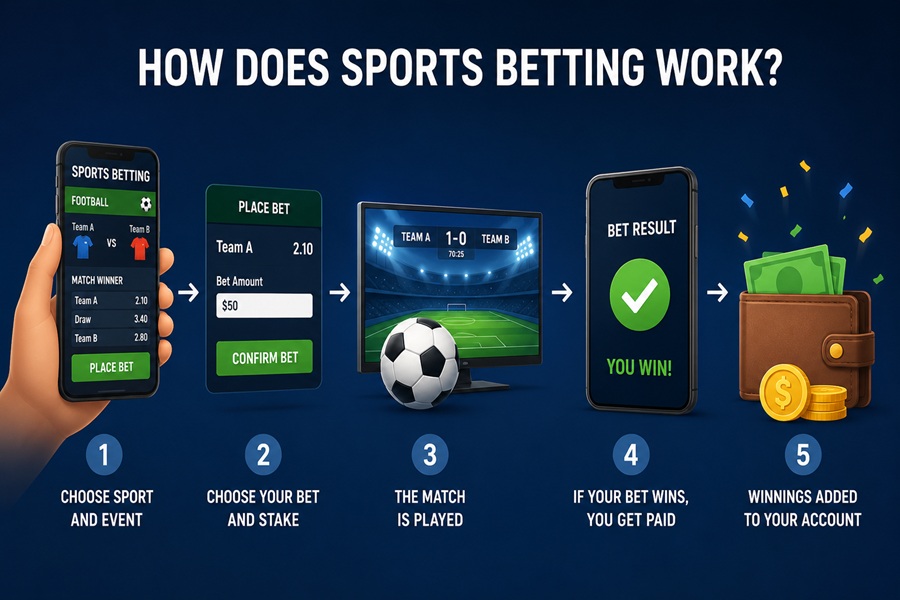
    Every bet follows the same five steps.

    1. The sportsbook posts a line for a game.
    2. You pick a side and a bet type.
    3. The book shows you a price (the odds) and a potential payout.
    4. Your money is held as the stake.
    5. When the game ends, you either get your stake plus profit, or you lose the stake.

    The book’s job is to attract roughly equal money on both sides. When the money is balanced, the book collects its built-in fee no matter who wins.

    That fee is the single most important thing new bettors miss. We cover it below.

    How do you read betting odds?

    Odds tell you two things at once: how likely the book thinks an outcome is, and how much you get paid.

    In the United States, odds use plus and minus signs. This is called American odds.

    Odds format What it means Example
    Negative (favorite) How much you must stake to win $100 -150 means risk $150 to win $100
    Positive (underdog) How much you win on a $100 stake +200 means a $100 stake wins $200

    A quick way to read it:

    • A minus number is the favorite. The bigger the minus, the stronger the favorite.
    • A plus number is the underdog. The bigger the plus, the bigger the potential payout.

    You do not have to bet exactly $100. The odds simply scale. A $10 stake at +200 wins $20. A $30 stake at -150 wins $20.

    Insight most guides skip: odds are just probability in disguise. A -150 price implies about a 60 percent chance. A +200 price implies about a 33 percent chance. Once you can convert odds to a percentage, you can spot when a price looks too generous or too short.

    What are the three main bet types?

    Almost every bet you will ever place is one of these three. Learn them and the rest is detail.

    1. Moneyline: who wins, plain and simple

    A moneyline bet is a bet on the outright winner. The margin does not matter. Win by one point or thirty, the bet pays the same.

    • Favorite: negative odds, smaller payout.
    • Underdog: positive odds, bigger payout.

    Use the moneyline when you are confident an underdog can win outright, or when a game is close to a coin flip.

    2. Point spread: the handicap that levels the game

    The point spread gives the underdog a head start and asks the favorite to win by more than a set number.

    If a football favorite is listed at -6.5, they must win by 7 or more for the bet to cash. The underdog at +6.5 wins the bet if they lose by 6 or fewer, or win the game.

    Spread bets are usually priced around -110 on both sides. That -110 is the fee (more on that next).

    Spreads have different names in different sports:

    • Run line in baseball, usually set at 1.5 runs.
    • Puck line in hockey, usually set at 1.5 goals.
    • Asian handicap in soccer, which can use quarter goals like -0.25 or -1.25.

    3. Totals (over/under): the combined score

    A totals bet ignores who wins. You bet on whether the combined score of both teams will go over or under a number the book sets.

    If a total is 44.5, an over bet needs 45 or more combined points. An under needs 44 or fewer. Totals also price around -110 on each side.

    Totals are driven by pace, weather, and key injuries. Wind above 15 mph in football, for example, is one of the most reliable signals that a total may stay low.

    A worked example: reading one game screen

    Here is a single football game as it would appear at any sportsbook.

    Team Spread Total Moneyline
    Chargers +6.5 (-110) Over 44.5 (-110) +230
    Jets -6.5 (-110) Under 44.5 (-110) -280

    From this one row you can read everything:

    • The Jets are the favorite (minus moneyline, minus spread).
    • The Chargers are the underdog getting 6.5 points.
    • The book expects a mid-scoring game (44.5 total).
    • A $100 moneyline bet on the Chargers would win $230. The same bet on the Jets would need a $280 stake to win $100.

    What is the vig, and why does it matter more than winning percentage?

    The vig (also called juice) is the small fee baked into the odds. It is the reason a spread is priced -110 instead of +100.

    Here is the math that trips up beginners.

    At -110, you risk $110 to win $100. If you bet two even games and go one for one, you do not break even. You win $100 on one and lose $110 on the other. Net loss: $10.

    That gap is the house edge. It means you need to win about 52.4 percent of spread bets just to break even, not 50 percent.

    This is the number that separates casual bettors from disciplined ones. Shopping for better prices, even -105 instead of -110, adds up over hundreds of bets.

    What other bet types should you know?

    Once the big three click, these expand your options.

    • Parlays: several bets combined into one ticket. All legs must win. Bigger payout, much lower odds of hitting.
    • Player props: bets on an individual, like passing yards or points scored.
    • Futures: long-term bets, like a team to win the championship.
    • Live (in-play) betting: odds that update in real time as the game unfolds.
    • Same-game parlays: multiple props from one game bundled together.

    Parlays and same-game parlays carry a much larger built-in edge for the book. They are fun, but they are the most expensive way to bet over time.

    What happens if the game lands exactly on the number?

    This is called a push. If a spread is -3 and the favorite wins by exactly 3, the bet is a push. Your stake is returned. No win, no loss.

    Books avoid pushes by using half-points, like -3.5. That guarantees a winner and a loser. This is also why numbers like 3 and 7 matter so much in football, since many games are decided by those exact margins.

    Why do the lines keep moving?

    A line is not fixed. It moves for two reasons.

    1. Money. If too much is wagered on one side, the book shifts the line to attract action to the other side and stay balanced.
    2. Information. A key injury, a lineup change, or bad weather can move a line fast.

    When a spread moves sharply in the hours before kickoff, it often reflects large, informed bets. Tracking that movement is one of the oldest skills in betting.

    How do sportsbooks always seem to win?

    They do not win every bet. They win over volume.

    By balancing the money and charging the vig, a book profits on the difference regardless of the result. Their edge is structural, not lucky.

    The whole US market shows the scale. Commercial sportsbooks took in roughly $167 billion in wagers last year, according to the American Gaming Association. Even a small percentage held on that much money is enormous.

    What are prediction markets, and how are they different?

    This is the fastest-moving story in betting, and most beginner guides ignore it.

    Prediction markets like Kalshi let people trade contracts on real-world outcomes, including sports. Prices are set by supply and demand, like a stock exchange, not by a bookmaker setting a line.

    The growth has been staggering. During the most recent World Cup, prediction markets captured around 27 percent of all legal US sports-betting volume, up from about 9 percent at the start of the year. Kalshi’s daily app users briefly passed both DraftKings and FanDuel.

    Why it matters to you as a beginner:

    • Prices move like markets, so you can often trade out of a position before an event ends.
    • They operate under federal (CFTC) oversight rather than state sportsbook rules, which is why they are available in some states where traditional sportsbooks are not.
    • The legal picture is still contested, with several states pushing back.

    You do not need to use them. But you should know they exist, because they are reshaping how Americans bet.

    What do experienced bettors say new bettors get wrong?

    Community forums like Reddit’s r/sportsbook and long-running betting boards repeat the same lessons. They are worth more than any tip service.

    • Manage your bankroll. Bet a fixed unit, usually 1 to 2 percent of your total betting funds, per wager. This keeps one bad night from wiping you out.
    • Never chase losses. Raising your stakes to win back a loss is the fastest route to a busted account.
    • Shop for the best line. The same bet is priced differently at different books. Small edges compound.
    • Ignore the hype. Screenshots of huge winning parlays are cherry-picked. Consistent small edges beat lottery tickets.
    • Treat it as entertainment money. Only bet what you can afford to lose.

    The single most repeated point across every forum is discipline over prediction. Knowing the games matters. Managing your money matters more.

    How do you place your first bet, step by step?

    1. Confirm betting is legal in your state.
    2. Register with a licensed, regulated sportsbook and verify your identity.
    3. Deposit funds. Start small.
    4. Pick a game and a bet type you understand (moneyline is the simplest start).
    5. Enter your stake. The app shows your exact payout before you confirm.
    6. Confirm and track the bet.

    Stick to bet types you can explain in one sentence until they feel automatic.

    Frequently asked questions

    Is sports betting the same as gambling?

    Yes. It carries real financial risk, and outcomes are never guaranteed.

    What is the easiest bet type for beginners?

    The moneyline. You are only picking a winner, with no spread or total to track.

    How much should I bet per game?

    Most disciplined bettors risk 1 to 2 percent of their bankroll per bet.

    Can I always win if I study enough?

    No. Even sharp bettors lose regularly. The goal is a long-term edge, not perfection.

    Where does my money go?

    Your stake is held by the book. Winners are paid from the pool, and the book keeps the vig as its fee.