Tag: what is spread betting

  • What Is Spread Betting? The Two Meanings (Sports vs. Financial) Explained

    What Is Spread Betting? The Two Meanings (Sports vs. Financial) Explained

    Quick answer: Spread betting has two completely different meanings. In sports, it means betting on the point spread, a handicap that makes a mismatched game an even wager. In finance, it means a form of leveraged derivative trading, popular in the UK, where you bet a set amount per point of price movement. They share a name and almost nothing else. This guide covers both so you land on the right one.

    Most articles about spread betting explain only one meaning and leave you guessing. That is a problem, because searchers arrive wanting very different things. Here is the full picture, side by side.

    The two meanings of spread betting at a glance

    Sports spread betting Financial spread betting
    What you bet on Margin of victory in a game Direction of a market’s price
    Where it is common United States and worldwide Mainly the United Kingdom
    How you win Your team beats the handicap The price moves your way
    Payout structure Usually fixed odds near -110 Scales with how far the price moves
    Legal in the US? Yes, where sports betting is legal No
    Uses leverage? No Yes

    If you came here from a sports search, read the first half. If you came from investing or trading, skip to the financial section.

    Part 1: Sports spread betting

    What is the point spread?

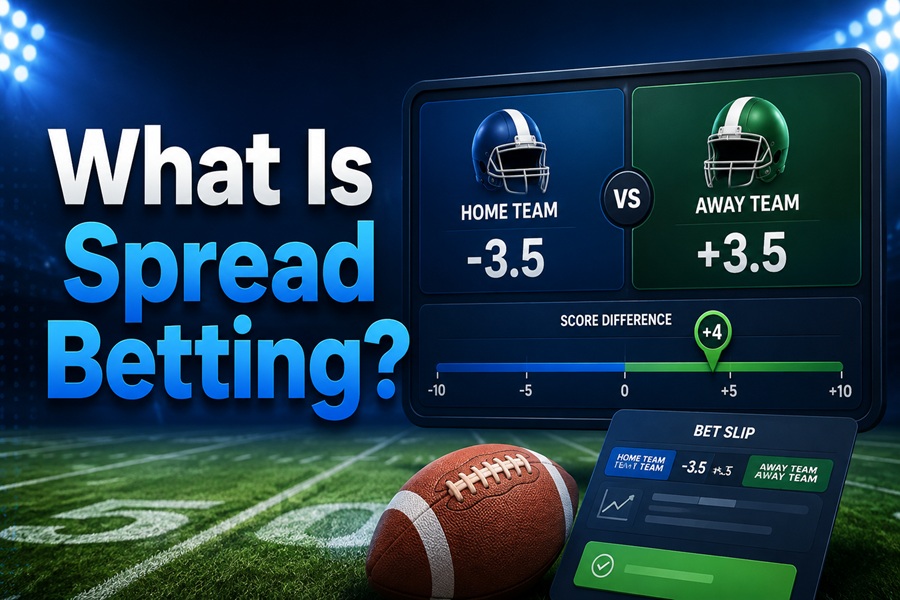
    The point spread is a handicap set by a sportsbook. It gives the underdog a head start and asks the favorite to win by more than a set margin.

    The goal is balance. Very few games are true coin flips. Without a spread, everyone would just bet the better team. The spread makes both sides an even wager, usually priced around -110 each.

    How does sports spread betting work?

    You pick a side against the spread, not just a winner.

    • The favorite has a minus spread, like -6.5. They must win by 7 or more to cover.
    • The underdog has a plus spread, like +6.5. They cover if they lose by 6 or fewer, or win outright.

    Example. A basketball favorite is listed at -6.5.

    • Favorite wins by 8: bet on the favorite wins.
    • Favorite wins by 4: bet on the underdog wins.
    • Underdog wins outright: bet on the underdog wins.

    The half-point (the .5) exists so there is always a clear winner, with no tie on the number.

    What is a push in spread betting?

    A push happens when the result lands exactly on a whole-number spread.

    If the spread is -3 and the favorite wins by exactly 3, the bet is a push. Your stake is returned. No win, no loss. This is why many spreads use half-points to avoid ties.

    What are spreads called in different sports?

    The concept is the same, but the name changes.

    Sport Name for the spread Typical value
    Football / basketball Point spread Varies by matchup
    Baseball Run line Usually 1.5 runs
    Hockey Puck line Usually 1.5 goals
    Soccer Asian handicap Can use quarter goals like -0.25

    Asian handicap is the most flexible. With a value like -1.25, part of your stake can win, lose, or be refunded, which reduces the risk of a total loss.

    Why do point spreads move?

    Spreads are not fixed. They shift for two reasons.

    1. Betting action. If too much money hits one side, the book nudges the line to balance the bets.
    2. News. Injuries, lineup changes, or weather can move a line quickly.

    A sharp move in the final hours before a game often reflects large, informed bets.

    When should you use the spread instead of the moneyline?

    • Use the spread when a favorite is heavily priced on the moneyline and you still expect a comfortable win. The spread pays better than a steep moneyline.
    • Use the spread on an underdog you think will keep the game close, even if you doubt they win outright.
    • Use the moneyline when you simply back an underdog to win, margin aside.

    Insight worth knowing: in football, the numbers 3 and 7 are called key numbers, because so many games are decided by exactly those margins. Getting +3.5 instead of +3 can matter far more than it looks.

    Part 2: Financial spread betting

    What is financial spread betting?

    Financial spread betting is a form of derivative trading. You speculate on whether a market’s price will rise or fall, without owning the underlying asset.

    You never buy the share, the currency, or the commodity. You place a directional bet on its price and stake a set amount per point of movement.

    It is especially common in the UK, where traders use it to access markets like a major stock index, currency pairs, gold, and individual shares from one account.

    How does financial spread betting work?

    Here is the mechanism, step by step.

    A market is quoted with two prices, a buy and a sell, for example 7500 to 7501.

    • If you think it will rise, you buy at 7501.
    • If you think it will fall, you sell at 7500.

    Then you choose your stake per point, say a fixed amount for every point the market moves.

    Your profit or loss is the number of points the market moves, multiplied by your stake per point.

    Example. You buy at 7501 and stake a set amount per point. The market rises 20 points. You win 20 times your per-point stake. If it falls 20 points instead, you lose that same amount.

    Why is financial spread betting considered risky?

    Two words: leverage and speed.

    • Leverage. You put up only a small percentage of the position’s value as margin. That magnifies gains and losses alike.
    • Speed. A market only has to move a little against you for losses to grow fast, especially in a volatile period.

    Because of leverage, you can lose more than your initial deposit if a position moves sharply against you. This is not a beginner-friendly product, and most spread betting providers openly warn that a majority of retail accounts lose money.

    Is financial spread betting legal in the United States?

    No. Financial spread betting is not legal in the US.

    It is well established in the UK, where it also carries a tax advantage for many users. In the US, this style of trading is prohibited, and traders use other instruments instead. This is one of the sharpest differences between the two meanings of the term.

    How to tell which “spread betting” you actually mean

    A quick test.

    • Are you talking about a game, a team, or a match? You mean sports spread betting (the point spread).
    • Are you talking about a stock, an index, a currency, or a commodity? You mean financial spread betting (the derivative product).
    • Are you in the US and it involves markets, not sports? That version is not legal for you.

    The shared name causes real confusion. Knowing which one you mean saves you from reading the wrong guide entirely.

    What do experienced bettors and traders say?

    Community discussion draws a firm line between the two.

    • On sports forums, the repeated advice is to shop for the best spread and price, respect key numbers, and manage a bankroll with small, fixed units.
    • On trading forums, the repeated warning is that leverage is unforgiving, that most retail spread-betting accounts lose money, and that risk controls like stop levels matter more than any single call.

    Different products, same underlying lesson from people with real experience: discipline and risk management beat bold predictions.

    Frequently asked questions

    Does spread betting mean sports or finance?

    Both. In sports it is the point spread. In finance it is a leveraged derivative traded per point. Context decides.

    What does a -6.5 spread mean?

    The favorite must win by 7 or more for a bet on them to win. The underdog covers by losing by 6 or fewer, or winning.

    Is spread betting the same as the moneyline?

    No. The moneyline is a bet on the winner only. The spread is a bet on the margin of victory.

    Is financial spread betting legal in the US?

    No. It is mainly a UK product and is prohibited in the US.

    Why do sportsbooks use half-point spreads?

    To guarantee a clear winner and avoid a push, where the stake is simply returned.

    Which is riskier?

    Financial spread betting, because leverage can produce losses larger than your deposit.